
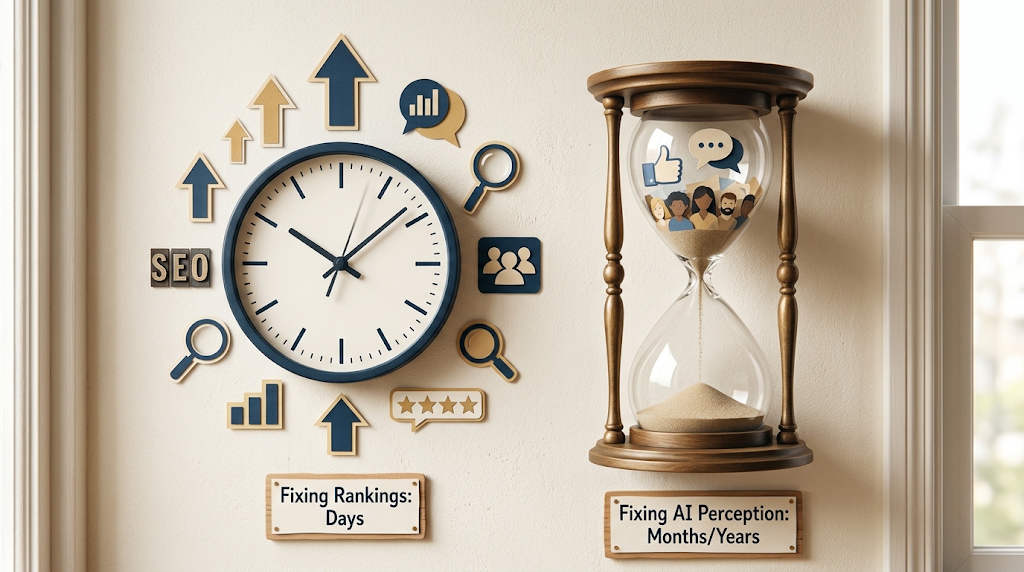
A company calls in March. A damaging 2023 article sits in position two for its brand name. By July, that article is on page three. By every metric online reputation repair has been measured on for fifteen years, that’s a win.
Then someone on the sales team asks ChatGPT about the company. The answer opens with the 2023 story.
Most people buying reputation repair services today don’t know this gap exists. Google rankings and AI answers run on separate clocks, and the AI clock is slower. Often a lot slower.
How long does online reputation repair take now?
Pushing negative results off page one of Google typically takes 3 to 6 months. Changing what AI tools like ChatGPT, Gemini, Perplexity, and Google AI Overviews say about a person or company usually takes 6 to 18 months. The difference comes from how AI builds an answer: it draws on live citations, the broader consensus of mentions across the web, and training data frozen months before the model shipped. Each moves at its own speed, and the slowest sets the pace.
That matters because buyers now act on what the chatbot tells them. A Semrush survey of 2,338 U.S. adults in July 2026 found 57.5% of AI users had decided not to buy something based on information a chatbot gave them. And 74.15% said they’d be at least somewhat less likely to buy if an AI flagged mixed or negative reviews.
Rankings were always the easy part
Traditional online reputation repair worked on a simple, visible system. Google shows ten links. If a negative article holds one of them, you build and promote stronger pages until they outrank it. Progress was easy to report: position 2 in March, position 14 in July.
The negative article never went anywhere. It just got harder for a person to see.
A person scrolling a results page, though, isn’t who you’re really dealing with anymore. The reader that matters is a retrieval system hunting for the passage that best answers a question, and it pulls from a much wider pool than the ten results a human skims.
AI doesn’t rank your reputation. It summarizes it.
When someone asks “is this company legit?”, an AI model doesn’t hand back a list and let them decide. It writes one answer, in a confident voice, and cites a handful of sources it picked.
Those sources are older than you’d guess. Ahrefs analyzed 16.975 million URLs cited by AI assistants and found the average cited page was 1,064 days old, close to three years. ChatGPT’s citations averaged 958 days. Google AI Overviews averaged 1,432 days.
So a three-year-old news story is exactly the kind of page AI likes to cite. Burying it on page three of Google doesn’t take it out of the retrieval pool. It’s still indexed, still relevant to the query, and often still the most specific thing written about the event.
The four clocks behind AI reputation repair
This framework explains why AI perception lags. Four separate timers are running, and a real repair plan has to account for all of them.
Clock 1: Search rankings (3 to 6 months)
This is the classic suppression timeline, and it still matters. Google remains a major input for AI Overviews and AI Mode, and pages that rank well get crawled and retrieved more often. Winning here is necessary. It’s no longer enough.
Clock 2: Live citations (weeks, but it keeps resetting)
Tools that search the web in real time swap sources quickly. A Scrunch and Stacker analysis of 3.5 million citation events found the median AI citation half-life is about 4.5 weeks. ChatGPT cycles fastest at 3.4 weeks. Perplexity holds sources longest at 5.8 weeks.
That sounds like good news, and partly it is. New, accurate content can start showing up in live answers within a month.
The catch is that it cuts both ways. Your positive citations decay just as fast unless something keeps replacing them. The same study found content distributed through editorial networks lasted close to 10 weeks, about 2.1 times longer than content without that distribution. Third-party placement isn’t a vanity metric here. It’s what keeps the correction from fading.
Clock 3: Consensus (6 to 12 months)
AI models report what the web broadly agrees on. In Ahrefs’ study of 75,000 brands, branded web mentions correlated with AI Overview visibility at 0.664. Backlinks came in at 0.218.
Think about what that means for a bad story. The original article is one mention. Then come the aggregator rewrites, the Reddit threads, the forum posts quoting it, the “company X controversy” pages. Suppressing the original does nothing to any of those. The model still sees a web where that story is a big share of what people say about you.
Changing consensus means outnumbering and outweighing the old narrative with credible, independent mentions: trade press, podcasts, interviews, industry directories, review platforms, video. Ahrefs’ follow-up research in 2026 found YouTube mentions were the strongest single signal of AI visibility across those same 75,000 brands. None of this happens in a quarter.
Clock 4: Model memory (12 months and up)
This is the clock almost nobody talks about.
When an AI answers without searching the web, it’s drawing on what it learned in training. Major models are trained on data frozen at a cutoff date, and in 2026 releases that cutoff typically lands 4 to 7 months before the model goes public. Older model versions also stay in service long after a newer one ships, inside apps, API integrations, and enterprise tools.
Run the math on that March cleanup. If the fix lands in May and a model releases in September with an April cutoff, the new model shipped with the pre-fix web baked in. It may stay in use for another year. The “fixed” reputation can keep surfacing for 18 months or longer, even when every page-one result looks clean.
Why suppression-only reputation repair services are selling a 2019 product
A provider that reports only on Google rankings is showing you one of four clocks.
Suppression-only campaigns tend to rely on thin, self-published assets. A bare profile page, a press release on a wire service, a blog post about the company written by the company. Those can rank. They rarely get cited. AI systems increasingly discount self-promotional sources, since a company’s claims about itself carry an obvious conflict of interest.
Worse, a sudden flood of puffy owned content can look exactly like what it is. It doesn’t give a model anything new to believe.
What AI will cite is specific, third-party, factual material. A trade publication profile with real numbers. A named executive quoted in an industry roundup. An updated Crunchbase entry. A Wikipedia article, where the subject actually meets notability standards. A body of recent reviews that address the old complaint head-on.
What a realistic timeline looks like
| Phase | What happens | What moves |
| Month 0 to 1 | AI audit: run 20 to 30 buyer-style prompts (“is [company] legit,” “[company] lawsuit,” “[company] reviews”) across ChatGPT, Gemini, Perplexity, Copilot, and AI Overviews. Log every cited source. | Nothing yet. You now know which sources are actually shaping the answer. |
| Month 1 to 3 | Fix the source layer: request corrections on factually wrong articles, pursue legal removals where they apply, update business profiles and structured data, clean up entity information. | Live citations start shifting. |
| Month 3 to 6 | Build and promote high-authority assets, earn first third-party placements. | Google rankings improve. Real-time AI answers soften. |
| Month 6 to 12 | Sustained earned media, podcast and video appearances, review generation, industry mentions. | Consensus shifts. AI answers lead with current facts instead of the old story. |
| Month 12 to 18+ | Ongoing monitoring across new model releases. | Model memory catches up as training cycles pick up the new web. |
The audit comes first for a reason. The cited sources tell you which assets are worth building and which old pages still carry weight. At NetReputation, that AI audit now happens before any suppression work gets scoped, because it regularly surfaces a forum thread or a 2022 aggregator page doing more damage than the article everyone was worried about.
What to ask before you hire anyone
If you’re comparing reputation repair services, these questions sort the current providers from the ones still running the old playbook:
- Do you report on AI answers, or only search rankings?
- Which prompts do you track, and on which platforms?
- How do you earn third-party mentions, rather than publishing owned content?
- What does month 7 look like, and month 13?
- How do you handle a model version that still repeats the old story after the web has changed?
A contract that ends at month six with a rankings report has paid for the first clock. If the chatbot your buyers use still opens with the 2023 story, the repair isn’t done, and the rankings report won’t tell you that.
FAQ
How long does online reputation repair take?
Moving negative results off Google’s first page usually takes 3 to 6 months. Changing what AI tools such as ChatGPT, Gemini, Perplexity, and Google AI Overviews say typically takes 6 to 18 months, because AI answers depend on live citations, the overall consensus of web mentions, and training data frozen months before a model is released.
Why does ChatGPT still mention a negative story after Google pushed it down?
AI tools don’t limit themselves to the top ten Google results. They retrieve the passages that best answer a question, and research from Ahrefs found the average page cited by AI assistants is about 1,064 days old. A suppressed article is still indexed, still relevant, and often still the most specific source on the topic, so the AI keeps citing it.
Do reputation repair services work on AI search results?
Some do, and many still don’t. Services that focus only on Google rankings address one part of the problem. Effective AI reputation repair also involves auditing AI answers directly, correcting information at the source, earning independent third-party coverage, and monitoring results across new model releases.
What influences how AI describes a company?
Branded web mentions have the strongest measured link to AI visibility. Ahrefs’ study of 75,000 brands found web mentions correlated with AI Overview visibility at 0.664, compared with 0.218 for backlinks. Its 2026 follow-up found YouTube mentions were the strongest single signal. Independent, factual mentions carry more weight than content a company publishes about itself.
How fast do AI citations change?
For AI tools that search the web live, citations turn over quickly. A Scrunch and Stacker analysis of 3.5 million citation events found a median citation half-life of about 4.5 weeks, ranging from 3.4 weeks on ChatGPT to 5.8 weeks on Perplexity. Content distributed through editorial networks lasted close to 10 weeks.
Why can an old reputation problem show up in a brand-new AI model?
AI models are trained on data captured at a cutoff date, which in 2026 typically falls 4 to 7 months before public release. If a reputation fix happened after that cutoff, the new model can still reflect the older version of the web, and older model versions often stay in use inside apps and integrations for a year or more.